Monday, February 3, 2014

Ephemeral:

not intended to be kept or preserved. Ephemeral art is understood in the creation process that it will only  be viewed for a finite amount of time. Is true ephemerality possible when documentation is involved?

Andy Goldsworthy

Goldsworthy creates works of art of moving, growing, and melting natural materials. Some of his work changes over time, while others completely disappear. The fact that it's still worth his invested time is important to the essence of ephemerality. It addresses the process of creation itself.


Paul Thek

Thek dismantles his artworks after each exhibit and discards them. The collections of objects include candles, onions, shoes, tissues, eggs, bathtubs, plants, and stuffed animals among other seemingly banal things. This degree of ephemerality transcends the belief that works of art will outlast the artist. His installations serve as meeting grounds for the material and the spiritual, the past and the present, the personal and the communal, and the divine and mundane. This addresses ideals of immortality. Does my inability to find pictures of these installations mean they weren't photographically documented, thus reaching a whole new ephemeral level?

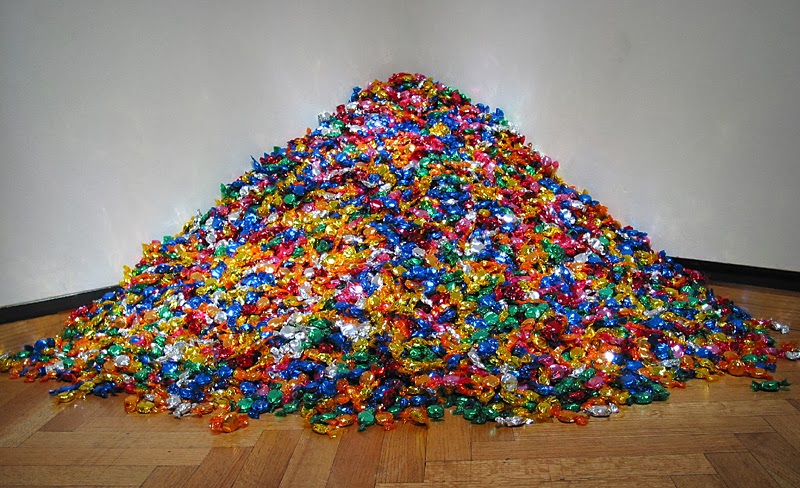
Felix Gonzalez Torres

In mostly untitled works, chocolates or cellophane-wrapped candies fill corners and stacks of papers are placed on floors of galleries. Viewers are invited to take the paper or candy, indicating that the work of art will never be the same once you come in contact with it. There's an implied unlimited supply which challenges the ephemeral nature of his works.


Barry McGee 

As a street artist, McGee's work will typically be removed or torn down. He says "I always thought it was a temporary thing. My stuff, in particular, I don’t give a darn about. That’s the nature of the beast" Fitting with the definition of ephemeral art, street artists understand during the creation of their art that it isn't timeless. This image is from the LACMA garage.


Damien Hirst

In The Physical Impossibility of Death in the Mind of Someone Living, 1991, Hirst uses a shark that was hunted and killed for the sake of art. This not only addresses the ephemeral nature of life, but also consider that this shark, although preserved, will fall apart over time. If another shark replaces this one, can the work of art ever be the same again? 


Abject:

a complex psychological, philosophical, and linguistic concept developed in Julia Kristeva's 1980 book Powers of Horror involving elements of the body that transgress and threaten our sense of cleanliness and propriety, and deemed inappropriate for public display or discussion. The term abject has a strong feminist context because artists are abjected by a patriarchal social order.

Julia Kristeva discusses the abject in terms of psychoanalysis. She mentions that some of the strongest loathings are that of food and of the corpse.

Andres Serrano

Piss Christ, 1987, is a photograph of a crucifix submerged in the artist's urine. The work incited quite an uproar- It's been called a deplorable, despicable display of vulgarity and has been torn down and banned. His use of the word "piss" instead of "urine" signifies anger and insult. It addresses what some viewers consider a foul excretion of the mortal body. 


Dash Snow

Snow's photos depict scenes of a sex, drug-taking, violent, art-world pretense with candor documenting the decadent lifestyle of a group of young New York City artists in the 2000s. His collage-based work was characterized by his semen splashed across photos of authority figures and newspaper articles. If his photos don't address the abject, his titles would- they imply incest, cannibalism, and rape.


Carolee Schneemann

Schneemann's works involve the undisguised presentation of female dreams, female body functions, and female genitalia. The stigmas that surround her work uncover the patriarchal credos that continue to influence the behavior of women as well as men. In particular, her use of menstrual blood as a medium of expression dramatizes deeply engrained cultural taboos. Blood Work Diary, 1971, consists of menstrual blood blotted on toilet paper arranged in a grid pattern on a wall. 


Libby Rowe

Rowe addresses the taboo topic of female masturbation in Language of Love, 2007, which features photographs of the hand positions of women. Her body of work encourages reconstruction of accepted social definitions of feminity and equality. 


Adrien Piper

Piper's street performances under the collective title Catalysis address ostracism and otherness through means of the abject. She stuffed a white towel in her mouth and rode on public transportation systems and doused herself with a mixture of vinegar, eggs, milk and cod liver oil and rode the New York City subways. They challenged the order of the social field at the level of distinction between public and private acts. 


Meme:

a concept for discussion of evolutionary principles in explaining the spread of ideas and cultural phenomena as defined by Richard Dawkins. Memes spread through the behavior that they generate in their hosts. A meme can be modified through replication. An internet meme is a concept that spreads rapidly from person to person via the internet.

Lauren Kaelin

Kaelin paints stills from reproducible, shareable, and recognizable internet videos and images. They challenge the theories of Walter Benjamin who, in a popular essay The Work of Art in an Age of Mechanical Reproduction, argued that a work of art lost its true value when reproduced. Her art straddles the border of fine art and internet virality.


Eva and Franco Mattes

This sculptural work is a copy of a cat internet meme with the caption "Don't Ask" below the image. The fact that this was made for a gallery show in which the couple imitated the work of another artist provides a double entendre to the concept of meme.


Francis Alys

Alys works from reproductions with commercial sign painters. As the imitative process continues, it asks questions about artists' relationships with painting and authorship. An infinite potential is implied, with the concept of memes reproducing and multiplying throughout the process.


Fashion Trends

It's hard to ignore fashion trends when researching reproduction through imitation in art. These Jeffrey Campbell shoes are semi-affordable designer knockoffs, which in turn are imitated for an even more affordable price. Other imitations in fashion follow seasonal trends that can be grouped and divided into categories like Typography and Slogans.


Mathew Zefeldt

Zefeldt uses clip-art style copy and pasting in his artwork with techniques reminiscent of MS Paint. His paintings invite viewers to consider the crisis of individuality in an era of instantaneous image sharing and replication. Like the other artists in this category, Zefeldt's time and skill put into his pieces juxtapose the effortless ability to share an image with a single click of a button. 


Slippage:

slipping away from a secure definition of art. In contemporary art, slippage can refer to the fusion of art and science, art and music, art and "real life", etc. Slippage can also refer to uncertainty within art (identity, authorship, relational aesthetics). The following artists exemplify the ambiguity of these definitive terms.

David Thorne

Thorne labels himself as a humorist and satirist, but many of his works are strikingly comparative to that of contemporary performative artists

10 Formal Complaints

Shannon Eats Lunch

Gilbert and George

Gilbert and George, two men functioning as a single entity, is a living sculpture. Every moment of their lives is dedicated to their artwork; they've established a rigid daily routine that exempts them from all activities unrelated to this artistic calling. Their "sculptures" are usually classified as the work of writers and performers, so the intention is what provides slippage in defining their art.

In The Singing Sculpture, 1969-, Gilbert and George stand on a pedestal in the middle of a gallery space and sing "Underneath the Arches" over and over again.


Their art also represents sordid scenes of loathsome behavior- the tragedy of the human condition. They subject themselves to excessive alcohol consumption and record the experience with multi-panel photographs. In these works the viewer is intended to question whether being drunk can be considered art.

Vito Acconci

Acconci regularly stretched the boundaries of traditional art definitions by becoming the object himself. In Following Piece he followed people around New York City until they went to a location he couldn't go. In Telling Secrets he told incriminating secrets about himself until he ran out of secrets. In Trademarks he sat on the floor of a museum and bit his body until marks were visible on his skin. This slippage provides a question of what exactly is the artwork. The skin? The photograph? The performance?


Psychology experiments

How do these differ from the aforementioned artists? Both provide information and insight for participants/viewers, and both elicit emotional responses.

Violinist in the Metro Station, 2007

The Milgram Experiment, 1961

Allen Kaprow and other Happening artists

Happenings were literally just things that happened and for this reason they are great examples of slippage. These question the art as object and the art as made by an artist, and whether or not these needed to be present in order for the work to be successfully deemed "art". In 18 Happenings in 6 Parts, 1959, Kaprow organized a large room with people inside and the situation would switch at the ringing of a bell. Happenings could be as seemingly random as someone peeling an orange or people playing musical instruments.


Sophie Calle

Calle is another artist who provides an example of slippage by questioning art as object. Here are some descriptions of her "artworks": follows a stranger to Venice, hires a private investigator to follow her, invites strangers to sleep in her bed, sends her bed to a lonely man in California, finds a man's address book and contacts every person in it, and gets a job as a hotel maid and takes photos of peoples' stuff. She uses a narrative photography format to document her process.


Monday, January 27, 2014

Definitions of Terms


affect: used as a synonym for passion, sentient, mood, feeling, or emotion. Aristotle's affect is a force embodied through pleasure and pain that shifts our condition and judgment. Descartes' affect is fortified by a movement of the spirit; the body and mind are allowed to communicate. Affect is affected by shifts in social arrangements, human cognition, and manipulation. 

appropriation: the direct taking over of an existing work of art or real object into a new work of art. The aim is to create a new situation or new meaning in association with a familiar image. It raises questions of authorship and originality. Collages usually involve appropriation. 

performance/performativity: the medium is the artist's own body and the artwork takes the form of actions performed by the artist. It is limited by it's ephemeral nature and the human characteristics of the body. It's recorded through photographs or video.

nomadism: the way of life of people who have no permanent home but move from one location to another, often following the seasons, trade routes, or food supplies.

body/embodiment: the physical structure and material substance of an animal, living or dead. Crosses over with themes of identity and performativity. The relationship of body and mind has been explored- feats of physical endurance and the ability of the mind to suffer pain. In the 1960s women focusing on bodily themes brought to attention the physicality of the female body through exploration of sexuality. Artists challenge ideals of bodies as only healthy and beautiful. Artists use the body as a site for social discourse, as a tool or medium (could be just part of the body), and to question or define beauty. To embody is to give a concrete form to an idea or spirit.

space/place (contested, liminal): a particular portion of space, whether definite or indefinite extent, set apart for a particular purpose. There are social, political, personal, and emotional memory-based associations attached to locations. Places can change physically and metaphorically, they can intersect time through memory and history, and they have literal or symbolic values that trigger physical and emotional responses. Some artists devote their work to the protection of particular places, while others construct or deconstruct artificial places.

surreal: initially led by Andre Breton and originally identified by Freud's research of the human mind where memories and our most basic instincts are stored. The aim of Surrealism was to reveal the unconscious and reconcile it with rational life. It was also associated with social attitudes and behavior through use of bodies or landscapes. 

conceptual: art that involves thinking beyond the limits of traditional media. Instead the ideas are worked out in whatever form is appropriate. All planning and decisions are made beforehand. Could be anything that doesn't take the form of a conventional art object, but frequently performance art and land art are placed under this category. 

permanence/impermanence (ephemeral): not intended to be kept or preserved. Understood in the creation process that environmental and performance art will only be viewed for a finite amount of time.

body politic: A group or nation could be likened to a human body. All the people that comprise a country are being considered a single group.

identity politics: how you view yourself, how others perceive you, and how society defines a group of people. Ethnicity, gender, age, class, sexual orientation, education, and life experience define identity. Questions the true nature of the self in terms of social or cultural identities. Work deals with the deconstruction of stereotypes.

happening: a non-verbal theatrical production that abandons stage-audience structure as well as the usual plot or narrative line of traditional theatre. Events were created by artists in the late 1950s and early 1960s (Fluxus), and typically took place in a  gallery setting. May involve improvisation and/or audience participation. Fluxus involves a continuous succession of changes and implies an alternative attitude towards art-making.

institutional critique: the act of critiquing an institution (a museum or art gallery) as artistic practice, a response to the art institution perceived as a place of cultural confinement and thus something to attack aesthetically, theoretically, and politically. popular in the 1960s, although in the 1990s the discussions were held within the galleries, making them not only the problem but the solution.

minimalist: work stripped down to the most fundamental features, rooted in reductive acts of Modernism, often interpreted as a reaction against Abstract Expressionism and a bridge to Postmodernism. Involves process art and conceptual art. It is unmetaphorical and self-referential. The reductive appearance shocked viewers and questioned the definition of art.

ornament: accessory, decoration, adornment, or detail that has been applied to an object or structure to beautify its appearance. 

kitsch: used in English to describe particularly cheap, vulgar, and sentimental forms of popular and commercial culture. Souvenir-like qualities might include plastic or porcelain models of Hello Kitty. Involved in Pop Art. Critic Clement Greenberg contrasted it with avant-garde styles. Judged to have little or no aesthetic value.

sublime: an artistic effect productive of the strongest emotion the mind is capable of feeling. Sublime is fear or reaction to terror present in Turner's landscapes and other Romantic art. Involves reality outside the human sense of perception.

utopian: an ideal or visionary system of political or social perfection. Often utilizes the creation of synthetic environments, because utopias are ultimately unrealizable.

vernacular: commonly appear in daily life in a particular culture; language written or spoken by ordinary, everyday people. Implies culture meaning negotiated within language. Also relates to photography in the form of snapshots.

abject: a complex psychological, philosophical, and linguistic concept developed in Julia Kristeva's 1980 book Powers of Horror involving elements of the body that transgress and threaten our sense of cleanliness and propriety, and deemed inappropriate for public display or discussion. Has a strong feminist context because they're abjected by a patriarchal social order. 

authorship: questioned in Postmodern art, along with authenticity and ideas of style progression. Especially linked with appropriation and kitsch, but also present in performance and environmental art. 

absence/presence: describe fundamental states of being, both self-referential dependent upon the notion of being. Reference Plato's "Allegory of the Cave, metaphysics, and deconstruction. Can something become absent if it was once present? Questioned in narrative photography (Cindy Sherman) among other media.

uncanny: incorporated new and unusual with mistrust, unease, and hostility. A correlation begins to emerge between new/foreign/hostile and old/known/familiar which gives rise to feelings of uncertainty associated with the uncanny. Considered by Freud to be a function of the unconscious and connected to a fear of death.

gaze: to look fixedly, intently, or deliberately at something, or to look vacantly or curiously about. Discussed in terms of art more consistently than any other synonym for "look". Gaze is used as a vehicle for communication that bridges the gap between art form and social theory. A gaze can either emanate from the viewer or from the work of art. Sartre saw the gaze as a battleground for the self to define and redefine itself; we become aware of the Self as object when confronted with the gaze of the Other.

posthuman: addresses the body as superfluous, indicating an ultimate goal beyond humanism. Some definitions are grounded in transcendence of certain human capabilities or features, while others are wholly without a trace of humanity. 

meme: from "mnemone" or "mimeme," Richard Dawkins defines it as a cultural element or behavioral trait whose transmission and consequent persistence in a population, although occurring by non-genetic means, is considered as analogous to the inheritance of a gene, especially imitation. Like genes, they may be given and received involuntarily, which is interesting in discussion of artists in terms of correlation with past art examples, especially in fashion.

phenomenology: the study of anything which may be a subject of observation, the starting point from which causality is determined. Often reserved for things which seem exceptional and extraordinary. 

social practice: a concept constructed by society. Artists blur the lines between object-making, performance, and activism that creates a participatory art that pushes "art" close to the breaking point. Includes providing social services to the general public and commissions of installations. 

new media: the mass influx of media that can enable the production and distribution of art digitally from CD-roms to mobile phones to the world wide web. Not only how art is initially shared but also shapes how art is talked about and revisited.

bio-art: raises questions about the future of life, evolution, society, and art. The dominant aspect is genetic art, specifically a green fluorescent rabbit genetically engineered in 2000. This will probably flourish and develop as access to biotechnology increases. Also brings up questions of purpose and authorship. 

eco-aesthetics: addresses art and literature in a period of climate change or discourse. Involves art as a strategy for improving the world, moving towards sustainability. Focuses on social or cultural identity. 

dichotomy (binary): division into two mutually exclusive or contradictory groups. The division of the "art" and "craft" distinctions as well as Art versus Life (or art as the opposition to life or death). Present in Dadaism and Fluxus. 

slippage: movement away from an original or secure place; tension between high art and popular culture. Showcases influential musicians as visual artists in gallery settings (Bowie, Byrne). Can be discussed in context with any new art movement and the transitory period between them or between individual artists.

Reference glossaries here, here, here, and here

Saturday, December 21, 2013

Dinner Party

The installation Dinner Party serves as an experiment in relational aesthetics. Participants are handed a set of rules by which to comply during a structured meal setting. They are served very small amounts of low calorie foods arranged in meticulous formations on a fully set table. The rules and dinners are inspired by pro-anorexia websites. What Dinner Party aims to explore is the relationship between people and food under extreme conditions. The behavior of participants is challenged by the rules they are inclined to follow. By placing restrictions on multiple people in a social setting, questions are asked about eating disorders and eating habits in general.

Thursday, December 19, 2013

Dinner Party

invitation front

invitation back

Rules For Eating handed out to participants
Plate #1

Plate #2

Plate #3
Plate #4